
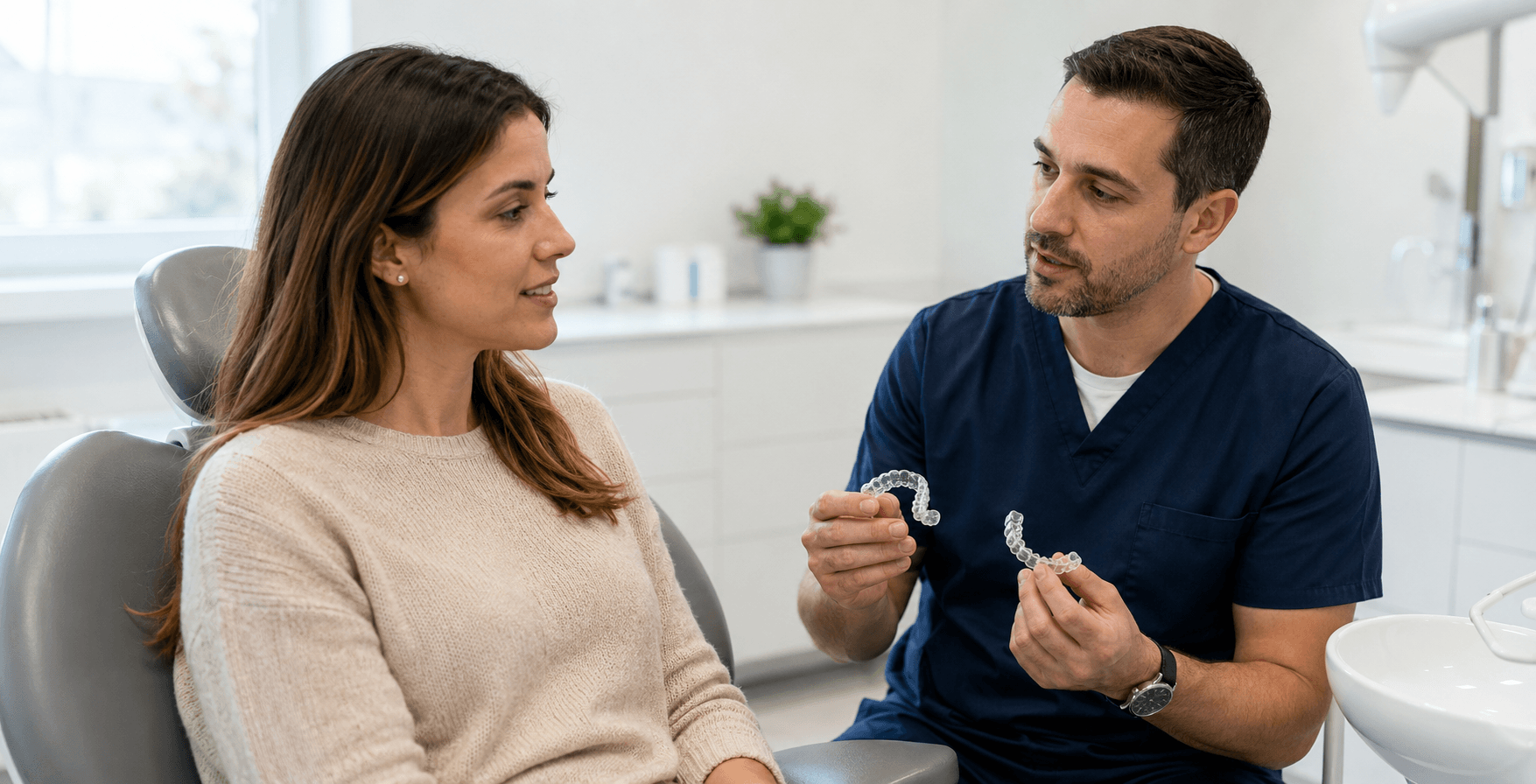
Clear orthodontic options may help some adults and teens straighten their teeth more discreetly than traditional metal braces. Depending on the treatment, this could mean fixed braces with tooth-coloured components or a series of removable clear aligners.
These options do not work in exactly the same way, and appearance is only one part of the decision. A dentist needs to assess the teeth, gums, bite, and treatment goals before recommending an approach. The type and extent of tooth movement required, oral health, age, and ability to follow care instructions may all affect treatment planning.
What Are Clear Braces?
The term “clear braces” can refer to more than one type of orthodontic treatment. Some people use it to describe fixed braces with clear or tooth-coloured brackets. Others use it more generally when talking about removable clear aligners.
Fixed clear braces are attached to the teeth and generally use brackets and wires to guide tooth movement. The brackets may be made from a tooth-coloured or translucent material, making them less noticeable than traditional metal brackets. Because they remain attached throughout treatment, patients do not need to remember to put them back in after meals.
Clear aligners are different. They are removable plastic trays created to fit over the teeth. Patients receive a planned series of aligners, with each set designed to support gradual tooth movement. They are removed for eating, drinking anything other than water, and cleaning the teeth.
Find out more about Eledent Family Dentistry’s page for clear braces in Mississauga to learn about ClearCorrect, a removable clear-aligner system rather than a fixed bracket-and-wire treatment. An assessment is needed to determine whether this type of treatment may be appropriate.
Clear Braces and Clear Aligners: How Are They Different?
Fixed clear braces and removable aligners can both be less noticeable than conventional metal braces, but they differ in how they are worn and cared for.
Fixed clear braces remain attached to the teeth. A dental professional makes adjustments during scheduled appointments to guide movement. Since patients cannot remove the appliance, it continues working without relying on them to remember to wear it. However, cleaning around brackets and wires requires additional care.
Clear aligners can be taken out. This allows patients to eat without the trays in place and brush and floss without working around fixed brackets. The aligners must be worn according to the instructions provided by the dental professional. Removing them too frequently or forgetting to put them back in may affect progress.
Other differences may include:
- How visible the appliance is when worn
- Whether it is fixed or removable
- The types of tooth movement it can support
- How brushing and flossing are completed
- Whether there are food restrictions
- How closely wear instructions must be followed
- The type and frequency of monitoring required
- How the appliance may affect speech during adjustment
Neither option is automatically more suitable for every patient. Some orthodontic concerns may be managed with aligners, while others may require a fixed appliance or another approach. The dentist may explain which features matter most based on the examination.
Patients researching Invisalign treatment should also understand that Invisalign is a specific brand of clear aligners. It is not the general name for every type of clear orthodontic treatment.
What Concerns May Be Addressed With Clear Orthodontic Treatment?
Clear braces or aligners may be discussed for certain concerns involving tooth position or the way the teeth meet. The suitability of treatment depends on the individual case rather than the appearance of one tooth alone.
An orthodontic assessment may look at concerns such as:
- Crowded or overlapping teeth
- Gaps between teeth
- Teeth that appear rotated
- Teeth that sit forward or behind neighbouring teeth
- Differences in how the upper and lower teeth meet
- A tooth that has shifted after previous orthodontic treatment
- Alignment that makes some areas difficult to clean
Two patients with similar-looking smiles may require different treatment plans. Tooth roots, jaw relationships, bite forces, gum health, and available space can influence what movement is possible and which appliance may be considered.
A dentist may also need to determine whether a concern is mainly cosmetic or whether it affects function. For example, a small visible gap may require a different discussion from a bite concern involving several teeth.
Clear orthodontic treatment is not intended to address every type of dental problem. Tooth decay, gum inflammation, damaged teeth, or other oral health concerns may need attention before orthodontic treatment begins. In some cases, a dentist may recommend additional assessment before deciding on an option.
What to Expect During an Orthodontic Consultation
An orthodontic consultation gives the dentist an opportunity to understand what the patient wants to change and assess the condition of the mouth. It also allows the patient to compare options and ask questions before making a decision.
The dentist may begin by asking:
- What would you like to change about your teeth?
- Have you had orthodontic treatment before?
- Have your teeth shifted over time?
- Do you experience difficulty biting or chewing?
- Do you clench or grind your teeth?
- Are you comfortable following daily aligner-wear instructions?
- How do you currently care for your teeth and gums?
The clinical examination may include the teeth, gums, bite, jaw relationship, and existing dental work. The dentist may look for crowding, spacing, rotation, wear, recession, or other factors that could affect treatment.
Photographs, dental X-rays, scans, or impressions may be recommended when clinically appropriate. These records can help the dentist evaluate tooth positions and structures that are not fully visible during a basic examination.
The discussion may cover:
- Whether orthodontic treatment may be appropriate
- Which type of appliance could be considered
- The movements the proposed treatment is intended to make
- The responsibilities associated with wearing and cleaning the appliance
- Factors that may affect treatment planning
- How progress may be monitored
- Whether retainers may be needed after active treatment
- Possible limitations or alternative approaches
The consultation does not guarantee candidacy for a particular system. It provides the information needed to develop a treatment plan based on the patient’s oral health and orthodontic needs.
Caring for Clear Braces or Clear Aligners
Daily care differs depending on whether the orthodontic appliance is fixed or removable.
With fixed clear braces, food and plaque can collect around brackets and wires. Patients may need to brush carefully around each bracket and use flossing aids or other tools recommended by their dental team. Certain hard, sticky, or chewy foods may damage fixed orthodontic appliances, so personalized eating instructions should be followed.
With clear aligners, patients generally remove the trays before eating and before drinking anything other than water. Teeth should be cleaned before the aligners are placed back in the mouth so that food and sugar are not trapped against the enamel.
General clear-aligner care may include:
- Wearing the aligners as instructed
- Removing them for meals and snacks
- Brushing and flossing before reinserting them
- Cleaning the trays using the recommended method
- Storing them in their case when not being worn
- Avoiding hot water that could affect their shape
- Keeping track of each aligner in the planned series
Patients should not use harsh cleaners or attempt to adjust an appliance themselves. If a tray cracks, stops fitting properly, or is lost, contact the dental office for instructions. For fixed braces, report a broken bracket, loose wire, or an area that is causing ongoing irritation.
Regular dental examinations and professional cleanings remain important during orthodontic treatment. Straightening the teeth does not replace the need for routine preventive care.
Common Questions About Clear Braces in Mississauga
Are clear braces the same as Invisalign?
Not necessarily. “Clear braces” is a broad phrase that may describe fixed braces with tooth-coloured brackets or removable clear aligners. Invisalign is a specific brand of removable clear aligners.
ClearCorrect is another clear-aligner system. Although it may be described as ClearCorrect braces, it uses removable trays rather than fixed brackets and wires.
A dentist can explain which systems are available and whether a particular approach may be suitable following an orthodontic assessment.
Can adults get clear braces?
Adults may be considered for clear braces or clear aligners. Age alone does not determine whether orthodontic treatment is appropriate. The health of the teeth and gums, the type of movement required, previous dental treatment, and the patient’s goals are also important.
Adults may have crowns, implants, missing teeth, gum changes, or other factors that require additional planning. A dentist can assess these considerations and discuss whether treatment is appropriate.
Teens may also be considered for clear orthodontic options, but the ability to follow cleaning or aligner-wear instructions can influence the recommendation.
How long can clear orthodontic treatment take?
There is no single treatment length that applies to every patient. Timing may depend on the starting positions of the teeth, the complexity of the bite, the amount of movement required, the chosen appliance, and how the teeth respond.
For removable aligners, following the recommended wear schedule and attending monitoring appointments are important parts of treatment. Fixed appliances also require regular care and professional adjustments.
A dentist may provide an estimated treatment range after completing the necessary assessment and planning. That estimate may change depending on how treatment progresses, so an exact completion date should not be guaranteed.
Talk to Eledent Family Dentistry About Clear Braces in Mississauga
Clear braces and clear aligners may offer adults and teens a more discreet way to address certain alignment concerns. However, the right approach depends on the teeth, gums, bite, treatment goals, and ability to care for the appliance.
If you are comparing teeth-straightening options, contact Eledent Family Dentistry to book an orthodontic consultation. A dentist may assess your oral health and alignment, explain the differences between available options, and discuss possible next steps based on the findings.